
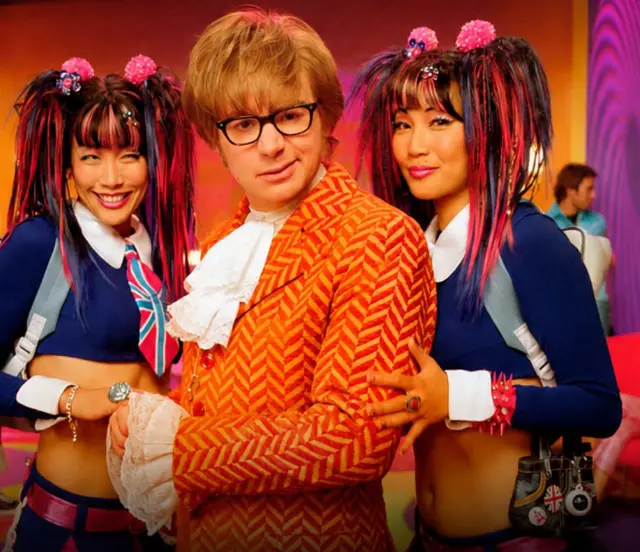
Few comedy franchises have left a cultural footprint as loud, strange, and enduring as Austin Powers, and now, after years of silence, the series has suddenly found itself back in the spotlight.
During a recent fan Q&A session, Mike Myers was asked the question audiences have been speculating about for more than two decades: whether Austin Powers 4 will ever become a reality.
Without hesitation, Myers gave a simple but explosive answer: “Yes.”

That single word was enough to reignite global excitement and send fans into immediate speculation mode about the return of one of comedy’s most iconic spy universes.
For a franchise that has been dormant since the early 2000s, the possibility of a fourth installment feels both nostalgic and unpredictable.
Myers also hinted that if the project does move forward, the story may shift its focus more heavily toward Dr. Evil, the absurd yet strangely lovable villain who became one of the standout characters of the entire series.
That creative direction alone has already sparked conversations across entertainment circles, as fans imagine how a deeper exploration of Dr. Evil could reshape the tone of a modern sequel.
The Austin Powers trilogy originally launched with International Man of Mystery in 1997, introducing audiences to a parody of classic spy films that blended retro aesthetics, exaggerated comedy, and unpredictable characters.
The film quickly developed a cult following, proving that its quirky humor and self-aware storytelling had struck a unique cultural nerve.
Two sequels followed—The Spy Who Shagged Me in 1999 and Goldmember in 2002—each expanding the absurd spy universe while pushing its comedic identity even further.
Across the three films, the franchise grossed more than 675 million dollars worldwide, turning Mike Myers into one of Hollywood’s most recognizable comedic voices.
Beyond financial success, the series became a defining pop culture phenomenon of its era, with catchphrases, costumes, and character quirks that are still referenced today.
Austin Powers himself, with his exaggerated confidence and comedic charm, became a parody icon, while Dr. Evil emerged as a villain who was equally funny, awkward, and strangely relatable.
What makes the current wave of interest particularly powerful is the timing.

Hollywood has seen a growing trend of legacy sequels and franchise revivals, bringing back beloved characters for both nostalgic audiences and new generations.
From long-awaited continuations of action franchises to reboots of classic comedies, studios have increasingly leaned into familiar intellectual properties with modern updates.
In this landscape, the idea of Austin Powers 4 feels less like a distant fantasy and more like a commercially viable possibility.
Mike Myers himself has occasionally addressed the idea over the years, though never with concrete production announcements.
In various interviews, he has expressed affection for both Austin Powers and Dr. Evil, often highlighting how much creative freedom the characters gave him as a performer and writer.
Dr. Evil, in particular, has been a recurring point of interest, with Myers suggesting that the character’s exaggerated personality still has unexplored comedic potential.
This recent “yes” response therefore feels less like a formal confirmation and more like a renewed openness to revisiting the universe.
Industry observers note that reviving Austin Powers would come with both opportunities and challenges.
On one hand, nostalgia-driven projects often perform strongly at the box office and streaming platforms, especially when tied to recognizable intellectual property.
On the other hand, comedy itself has evolved significantly since the early 2000s, and what once defined mainstream humor may require careful adaptation to resonate with today’s global audience.

Balancing the original film’s bold satire with modern sensibilities would be one of the key creative challenges for any potential fourth installment.
Another major factor is audience expectation.
Fans of the original trilogy have spent over 20 years imagining what a continuation might look like, and that long gap creates both excitement and pressure.
Any new film would need to honor the original tone while also offering something fresh enough to justify its return.
This is especially important in a franchise known for its cultural specificity, exaggerated humor, and era-based references that were strongly tied to the late 90s and early 2000s.
The potential focus on Dr. Evil could be one of the most strategic creative decisions if the project moves forward.
Unlike Austin Powers himself, Dr. Evil’s character offers more flexibility for storytelling, especially in a modern context where villain origin stories and character-driven spin-offs have become increasingly popular.
A deeper exploration of his backstory, motivations, or even a comedic redemption arc could open the door to a new narrative direction while still preserving the franchise’s signature humor.
Fans have already begun speculating across social media about what a modern Austin Powers 4 could look like.
Some imagine a storyline where Austin is pulled out of retirement to face a completely changed world of espionage, while others believe the film could lean more heavily into Dr. Evil’s perspective.
There are also discussions about whether the franchise would maintain its retro spy aesthetic or evolve into a more contemporary parody of modern intelligence culture.
Despite the excitement, it is important to note that no official production has been confirmed.
There is currently no announced studio schedule, release timeline, or supporting cast details attached to the project.
Myers’ comment, while encouraging, remains an informal statement rather than an official green light from a production company.
However, in Hollywood, even a single word from a major creator can be enough to trigger development conversations behind the scenes.
Streaming platforms may also play a significant role in the franchise’s future.
With the rise of digital releases and global content distribution, a revival of Austin Powers could find new life outside traditional cinema.
A streaming-exclusive sequel or hybrid release model could provide more creative freedom while reaching a broader international audience.
This would also align with current industry trends where legacy franchises are being reintroduced through digital-first strategies.
Ultimately, the return of Austin Powers remains uncertain, but the reaction to Mike Myers’ brief answer reveals something much more definitive: the franchise is still deeply loved.
Few comedy series maintain cultural relevance for over two decades, yet Austin Powers continues to attract attention, discussion, and anticipation.
Whether or not Austin Powers 4 becomes reality, the enduring popularity of its characters proves that its comedic legacy has not faded with time.
And for fans waiting since 2002, even a single word—“Yes”—is enough to reopen the door to a world of shagadelic possibility.