
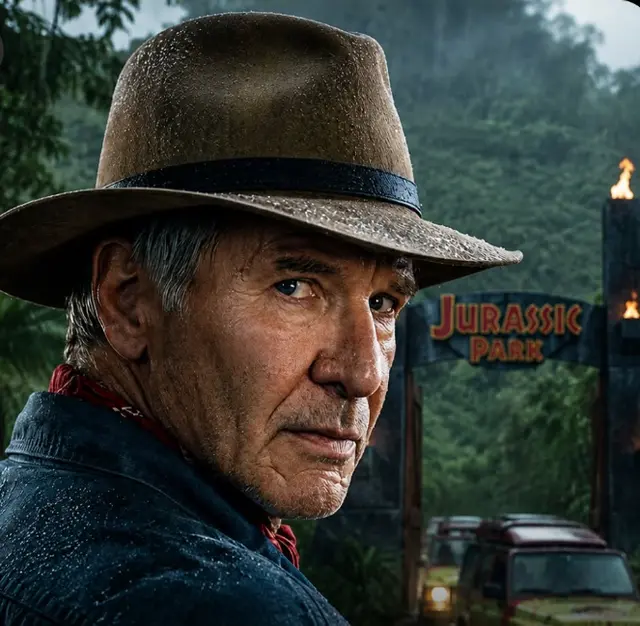
Before Jurassic Park became one of the most influential blockbusters in cinema history, it nearly looked very different. According to long-circulating Hollywood production stories, director Steven Spielberg originally wanted Harrison Ford to star in the film, but the actor ultimately turned the role down—leaving Spielberg deeply disappointed at the time.
Today, Jurassic Park is remembered as a groundbreaking masterpiece that reshaped visual effects, blockbuster storytelling, and modern cinema itself. But behind its legendary success lies a fascinating “what if” scenario that could have changed movie history forever.

A Blockbuster That Changed Hollywood Forever
When Jurassic Park was released in 1993, it wasn’t just another summer movie—it was a cinematic revolution. Audiences had never seen dinosaurs brought to life with such realism, combining practical effects, animatronics, and early CGI in a way that felt groundbreaking and believable.
Directed by Steven Spielberg and based on Michael Crichton’s novel, the film became an instant global phenomenon. It redefined what audiences expected from visual storytelling and set a new standard for blockbuster filmmaking.
But long before the T-Rex roared onto the big screen, Spielberg was assembling his dream version of the film—and that version reportedly included one of Hollywood’s biggest stars.
Spielberg’s First Choice: Harrison Ford as the Lead
At an early stage of development, Spielberg reportedly had Harrison Ford in mind for a major role in Jurassic Park, most likely Dr. Alan Grant—the rugged paleontologist eventually played by Sam Neill.
At the time, Ford was already one of the biggest names in Hollywood. Having defined two legendary franchises—Indiana Jones and Star Wars—he was the ultimate action-adventure star. To Spielberg, Ford represented exactly the kind of grounded, charismatic presence needed to anchor a story filled with chaos, science fiction, and prehistoric terror.
The idea made sense on paper:
- Ford had proven adventure-hero credibility
- He could balance toughness with vulnerability
- He had global star power that could elevate the film even further
For Spielberg, Ford seemed like a natural fit for a story about survival against impossible odds.
The Role That Went to Sam Neill Instead

Ultimately, Harrison Ford passed on the project. While the exact reasons have never been fully confirmed, reports suggest that scheduling conflicts, script considerations, or creative direction may have influenced his decision.
With Ford out, the role of Dr. Alan Grant went to actor Sam Neill, whose quieter, more grounded performance became one of the defining elements of the film.
Neill’s portrayal gave Grant a very different tone than what audiences might have seen with Ford:
- More academic and reserved
- Less action-hero swagger
- A slow emotional transformation from skeptic to protector
This version of Alan Grant became iconic in its own right, proving that sometimes casting changes lead to unexpectedly perfect results.
Spielberg’s Reaction: “Crushed” by the Decision
According to industry anecdotes, Spielberg was reportedly “crushed” when Harrison Ford declined the role. The disappointment makes sense—Ford was one of his most trusted collaborators, especially after their work on Indiana Jones, one of cinema’s most successful partnerships.
Losing Ford meant rethinking not just casting, but also the tone and emotional structure of the character. Spielberg had to move forward with a different interpretation of Grant—one that ultimately shaped the final identity of Jurassic Park.
Despite the initial setback, Spielberg’s ability to adapt would soon lead to one of the greatest films ever made.
How Jurassic Park Still Became a Masterpiece Without Ford

Even without Harrison Ford, Jurassic Park succeeded beyond expectations. In fact, many argue that the final cast was perfectly balanced for the story Spielberg wanted to tell.
Sam Neill brought intellectual seriousness and emotional restraint to Alan Grant. Laura Dern added energy, intelligence, and emotional depth as Ellie Sattler. Jeff Goldblum, meanwhile, delivered one of the most memorable performances of his career as Ian Malcolm, injecting charisma, humor, and philosophical chaos theory into the narrative.
Together, the ensemble created a dynamic that:
- Felt believable under extreme circumstances
- Balanced science, fear, and wonder
- Allowed dinosaurs to feel like the true stars of the film
What Harrison Ford Could Have Brought to Jurassic Park

Even though Sam Neill’s performance is widely praised, fans often speculate about what Harrison Ford would have brought to the role.
If Ford had played Alan Grant, the character may have leaned more toward:
- A traditional action-adventure archetype
- Greater physical dominance in survival scenes
- A more sarcastic, Indiana Jones-style personality
This alternate version of Jurassic Park might have felt more like a classic adventure film rather than the suspense-driven science thriller we know today.
It also raises an interesting question: would the tone of the entire movie have shifted if Ford had accepted?
Two Legends, Two Different Universes
Harrison Ford and Steven Spielberg eventually created magic together through the Indiana Jones franchise, which already embodied the kind of adventurous spirit Ford might have brought to Jurassic Park.
In a way, the universe aligned itself differently:
- Indiana Jones became Ford’s iconic adventure legacy
- Jurassic Park became Sam Neill’s defining role
- Spielberg got two different cinematic identities instead of merging them into one
Rather than diminishing the film, the casting change helped diversify Spielberg’s storytelling legacy.
Why This Casting Story Still Fascinates Fans

Decades later, fans remain fascinated by this behind-the-scenes “what if” scenario. Stories like this endure because they reveal how close iconic films come to being completely different.
The idea that:
- One casting decision could reshape a blockbuster
- A different actor could redefine a character’s identity
- A Hollywood legend almost joined another franchise-defining role
…adds another layer of mystery to an already legendary film.
It also highlights how unpredictable filmmaking truly is. Even the biggest movies in history are shaped by timing, availability, and creative instinct.
Jurassic Park’s Lasting Legacy
Regardless of casting what-ifs, Jurassic Park remains one of the most important films ever made. It:
- Revolutionized CGI and animatronics
- Influenced generations of filmmakers
- Spawned a massive franchise that continues today
- Became a cultural touchstone across the world
Its impact goes far beyond casting decisions. It represents a turning point in cinema where technology and storytelling merged in ways audiences had never experienced before.
Conclusion: A Legendary Film Born From Unexpected Choices
The story of Steven Spielberg wanting Harrison Ford for Jurassic Park is a reminder that even the most iconic films are shaped by missed opportunities and creative pivots.
While Spielberg may have initially been “crushed” by Ford’s decision to pass, the final result proved that sometimes the best outcomes come from unexpected paths. Sam Neill’s portrayal of Alan Grant helped define the emotional core of the film, contributing to its lasting success.
In the end, Jurassic Park didn’t need Harrison Ford to become legendary—it was already destined for greatness.
But the “what if” remains one of Hollywood’s most fascinating alternate histories:
What if Indiana Jones had ever stepped into Jurassic Park?